

The range might have been the first thing you checked before deciding which electric car to buy. After all, choosing an EV capable of plenty of miles between charging stops could save you vast amounts of time and money.
That said, with an increasing number of electric cars able to travel 300+ miles on a single charge, so-called ‘range anxiety’ is quickly becoming a thing of the past. Yet it makes sense to preserve – or even extend – the distance your car can travel before its battery runs flat. It helps both the environment and your bank balance.

Clearly, suggesting that you upgrade from a used electric vehicle with 100 miles of range to a new one capable of 300 miles isn’t especially helpful. That’s why we have created a list of ways you can get the maximum range from your electric car without having to spend any more money.
Our list is presented in no particular order. However, if you use any or all of the following tips, we promise you will boost the range of your electric car.
Check your speed
Electric cars are most efficient when driven at speeds of between 50mph and 60mph. According to Department for Transport figures, you will use 14 percent less energy if you reduce your motorway speed by 10mph, so it pays to ease off.
It’s all about making life easier for your car’s battery, because the faster you go, the harder it has to work to tackle aerodynamic drag.
Avoid motorways

Linked to lowering your speed, it actually pays to avoid motorways. You’ll be able to travel significantly further at 60mph than at 70mph, but your car’s range will decline if you drive at the motorway speed limit.
If you are prepared to add a little time to your journey, use a route planning app such as Waze or Google Maps and select ‘avoid motorways’. You’ll be amazed at the difference it can make, and because you’ve lowered your speed, it should mean fewer visits to a public charging points. So your journey may not take longer after all. It might be more interesting and enjoyable, too.
Smoothly does it
Late braking and sudden acceleration are two things to avoid when you’re looking to maximise range. Build your speed slowly and scan the road ahead to look for junctions, roundabouts and situations that might require sudden braking.
It’s worth remembering that electric cars are heavier than their petrol and diesel equivalents, which means more energy is required to make progress. If you can maintain this forward momentum, you will preserve your battery’s charge and therefore the range of your EV.
Driving mode
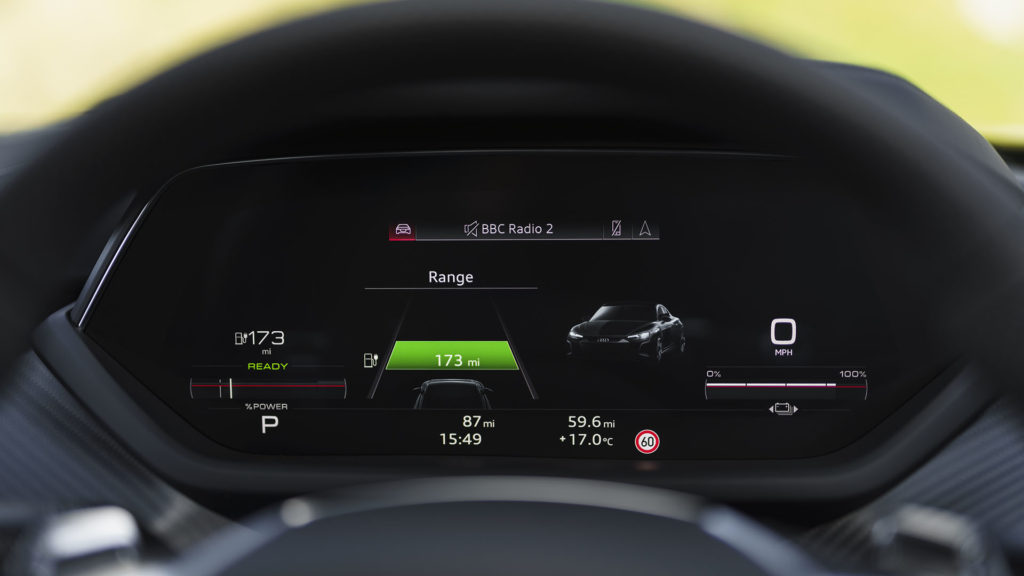
Many electric cars feature different driving modes to control parameters such as throttle response and the level of regenerative braking, along with the efficiency of systems like the climate control. Anything you can do to reduce the drain on your battery will maximise the range, so use ‘Eco’ mode where possible.
Regenerative braking
Speaking of regenerative braking, by recapturing energy that would have been lost as heat, you can actually add miles to your car’s projected range. It’s quite simple to use: you just take your foot off the accelerator and allow the electric motor to harvest energy as the car slows down.
Some cars are better at doing this than others, and many give you the option to select the strength of regenerative braking. Others even allow you to accelerate, decelerate and stop the car using only one pedal, which soon becomes very intuitive.
Check the tyre pressures
An electric car’s range will be positively or negatively affected by the tyre pressures, so get into the habit of checking them regularly. Invest in a tyre pressure gauge or use one at your local petrol station, because driving with under-inflated tyres will put a dent in your car’s range.
Similarly, when it comes to buying new tyres, choose rubber that matches the manufacturer’s specification or is designed specifically for electric vehicles,
Get into the habit of preconditioning

As we pointed out in our guide to preconditioning, this is one of the lesser-known and underappreciated features of electric cars. It allows you to heat or cool the vehicle’s cabin before you start your journey. As well as making you feel more comfortable, you’ll also preserve the predicted range, because the energy required to heat or cool the interior will be drawn from the mains electricity supply and not your car’s battery.
What’s more, when you start your journey, your battery can be focused on powering the car and not altering the cabin temperature.
Use the heated seats
If it’s just you in the car, consider using the heated seats (and heated steering wheel if fitted) instead of blasting out hot air. This is a more efficient way of warming you up on a cold morning because the car is essentially heating you and not the entire cabin.
When you’re feeling toasty, switch the seat and wheel heating off again to preserve range. You should also be able to turn on these accessories as part of the preconditioning process (see above).
Use accessories sparingly

Most of us like waking up to a fully charged smartphone, but you know that it doesn’t take long for the battery to run down. Some time spent on social media, the use of a mapping app and streaming a video will soon put a dent in the phone’s charge status.
It’s a similar story in an electric car; charging your phone, using the climate control, listening to the radio and driving with headlights on will all eat into the projected range. Nobody is suggesting you turn everything off – killing the air-con and driving with steamy windows is a bad idea – but just remember that every accessory will put an additional strain on the battery.
Look after your battery
This is more of a long-term approach, so you won’t see any immediate results, but caring for your battery will pay dividends over time. Charging the battery once it hits 10 percent and recharging to 80 percent is the key to preserving battery life, which means your car’s official range estimate will remain higher for longer.
Equally, avoid regular use of public rapid chargers, running the battery down from 100 percent to zero, and leaving the battery on charge when it’s full. Look after your EV’s battery and, over time, it will look after you.
ALSO READ:
Can I charge an electric car using a three-pin plug?

[…] This was compounded in October with the launch of a Model 3 Long Range Rear-Wheel Drive – the longest-range Tesla vehicle yet. The firm will hope the upcoming Model Y facelift, due in the UK from June, can […]
[…] that states the SoH as a percentage, such as ‘>95%’. It allows customers to compare the potential range of a used Polestar 2 with its ‘as new’ figure (derived from the official WLTP […]
[…] Gladman of IAM RoadSmart said: “If travelling a long distance try to arrange your travel to coincide with nap time or bed time – this may make for a more […]