

When electric cars first gained popularity around a decade ago, it was easy to find free or cheap places to recharge. At worst, you’d pay £10 for a card that gave you access to roadside charging points for a year.
That couldn’t last for long – and inevitably, it hasn’t. Nobody can afford to give motorists free fuel, even if they are driving efficient cars. So now there is a significant cost to use most public chargers – and it’s almost always cheaper to charge your EV at home.
Another issue with free public charging stemmed from the increasing number of plug-in hybrid vehicles (PHEVs) on the roads. These cars – which use both a combustion engine and an electric motor – have less need to top up as they can switch to petrol power if needed..
However, PHEV drivers may choose to charge if electricity is free. Introducing a cost frees up charging points for use by battery-electric cars.
Council roadside and car park chargers

You will be lucky to plug in without paying in England, Wales or Northern Ireland today, although there are still a significant number of free chargers in Scotland (operated by ChargePlace). However, you will have to pay a small membership fee upfront.
Bear in mind that you may still need to pay parking charges as well, even if charging your car is free.
Filling stations

Sadly, there is no chance of finding free electricity at petrol stations now. However, the number of charging points is growing rapidly in these locations, thanks to networks such as Shell Recharge (pictured above) and BP Pulse.
In future, some petrol stations are likely to be converted to EV-only charging hubs – following the example of the Shell site in Fulham, London.
Supermarkets
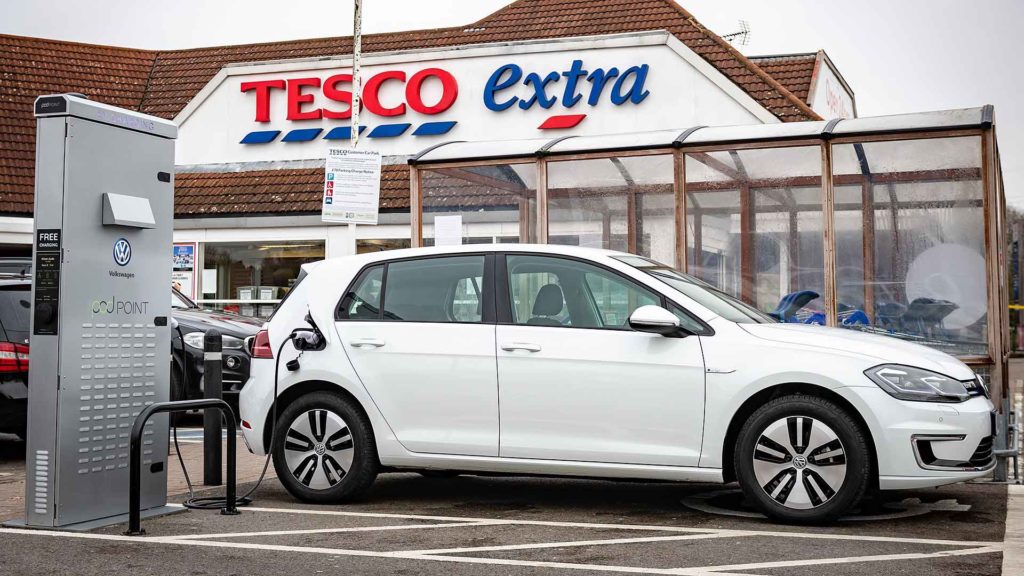
Again, free chargers at supermarkets are now few and far-between, although they can still be found at some Aldi and Lidl stores.
Tesco originally partnered with Volkswagen and Pod Point to provide thousands of free 7kWh charging points across the UK, but this offer has now been withdrawn. Topping up at Tesco now costs between 44p and 69p per kWh, depending on the speed of the charger.
Car dealers

Every car dealer that sells electric cars has at least one charging point and may allow customers to charge for free. In our view, though, that’s far from a realistic as an ongoing solution.
Firstly, car dealers are often in places that are out of your way (although the better ones will offer decent coffee and a waiting lounge). Secondly, the point is usually in use to recharge their own demonstration vehicles. And finally, have you seen how packed dealer car parks are? It can be impossible to park anywhere.
Hotels

Many hotels, and even some B&Bs, offer electric charging for their customers – and with a modicum of luck you can do this at no additional cost. According to the latest numbers from ZapMap, 352 hotels and accommodation sites in Britain still offer free EV charging.
We can’t think of a nicer place to stop than a country house hotel, where you can imbibe tea and cake while your car is being charged.
Tesla owners
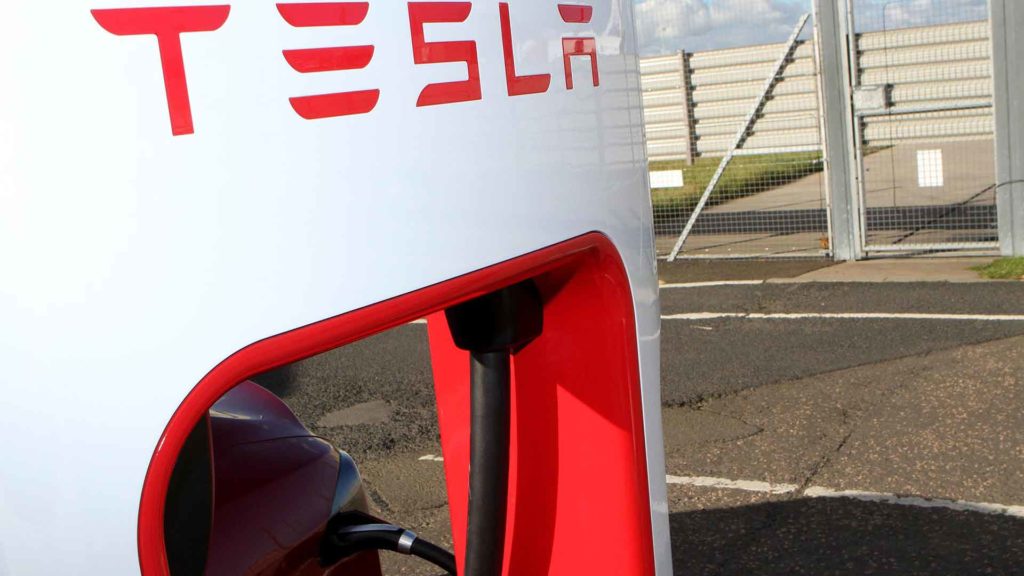
This is complicated. Owners of the early Model S and Model X Teslas received free use of the Supercharger network for the lifetime of their car. You could also pass this on to subsequent owners. Later, you couldn’t pass it on, then the benefit was withdrawn altogether for more recent buyers.
Tesla has tried to phase out free Supercharging by offering special trade-in deals to those owners who benefitted from it. Contact Tesla before buying an older (pre-2021) Model S or Model X to check if that particular vehicle comes with free Supercharging. It’s a huge potential benefit if so.
All owners of the smaller Tesla Model 3 and Model Y have to pay for charging in the UK. However, there are sometimes offers if you are referred by an existing Tesla owner, such as one deal that offered ‘1,000 miles’ of free charging with every new car.
ALSO READ:
How does regenerative braking boost your electric car’s range?