

For years, drivers of non-Tesla electric cars could only stare at Tesla Superchargers with envious eyes. The American brand’s first dedicated charging site opened back in 2012 and its network has since grown to more than 70,000 Superchargers worldwide. Unquestionably, the Supercharger network is one of the reasons for Tesla’s incredible success.
Things changed in November 2021, when Tesla launched a pilot scheme for non-Tesla electric vehicles to use its previously private network. The programme was limited to 10 sites in the Netherlands, with Tesla saying that ‘access to an extensive, convenient and reliable fast-charging network is critical for large-scale EV adoption’.
Building on the success of this trial, Tesla then extended the scheme to other European countries, including the UK, where non-Tesla electric car owners were initially granted access to 15 Supercharger locations. Today, upwards of 50 Supercharger sites are open to other cars.
Where is non-Tesla Supercharging available?
At the time of writing, non-Tesla Supercharging is available in the following countries:
- Europe: Austria, Belgium, Denmark, Finland, France, Germany, Hungary, Iceland, Ireland, Italy, Luxembourg, Netherlands, Norway, Romania, Spain, Sweden, Switzerland, Turkey, United Kingdom
- North America: Canada, United States
- Asia Pacific: Australia, New Zealand, Mainland China, South Korea
Where is non-Tesla Supercharging available in the UK?
The number of non-Tesla Supercharger stations in the UK is growing steadily, including locations across Scotland and Wales, plus a single site in Dungannon, Northern Ireland. For the latest information, you’re advised to visit the Zapmap website. Simply use the ‘Tesla Public Supercharger’ filter.
UK electric car owners can also use the public access Supercharger network across Europe.
What is the Tesla Supercharger network?
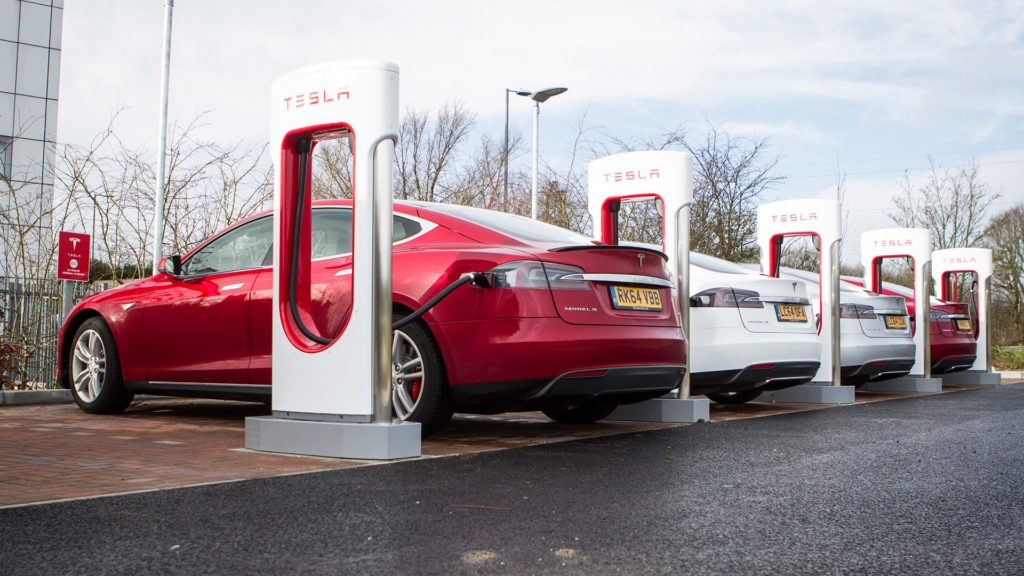
There are three types of Tesla Superchargers in the UK: V2 (speeds of up to 150kW), V3 (up to 250kW) and the latest V4 (up to 350kW). Each charging unit will use one of two cables: Type 2 (Tesla Model S and Model X) or CCS (Combined Charging System – Tesla Model 3 and Model Y, plus compatible non-Tesla electric cars).
It’s the 10th largest EV charging network in the country, so having access to Tesla’s Superchargers is a real bonus for electric car owners. The majority of charging points are located on or close to major roads, although others can be found in hotels or venues where people spend a longer period of time. These are known as ‘Destination chargers’.
Can all non-Tesla electric cars use Superchargers?
Non-Tesla Supercharging is only accessible for CCS-enabled electric cars. EVs with other connectors cannot use Tesla’s chargers. In the UK, this primarily means older examples of the Nissan Leaf and Renault Zoe, plus some Lexus models.
Some Supercharger stations have shorter cables designed for Tesla vehicles, which might be a stretch for non-Tesla electric cars. Tesla advises: ‘Please do not obstruct other cars by parking over the lines if the cable cannot comfortably reach your car’.
How do drivers of non-Tesla EVs use a Supercharger?
The Tesla smartphone app is required to create a Tesla account. Once you have downloaded it, select ‘Charge Your Non-Tesla’ and find the nearest Supercharger site.
Add a payment method, connect the car to the charging point and select ‘Start Charging’. Select ‘Stop Charging’ to complete the session.

How much does it cost to use a Tesla Supercharger?
Prices vary by location and time of day, and are available in the Tesla app. However, drivers can potentially save by signing up for Supercharging membership (Tesla owners are automatically members), which costs £8.99 a month or £90 for the year. The average price for non-members is around 60p per kWh. Member discounts range from 10p to 20p per kWh.
It’s also worth noting that Tesla charges idle fees when a fully charged electric car remains connected to Supercharger. Designed to reduce queues, these only apply when a Supercharger station is at 50 per cent capacity or more. However, the idle fee of 50p per minute doubles to £1 per minute when the station is 100 percent occupied.
ALSO READ:
Can I charge an electric car using solar panels?
What is Plug & Charge for electric cars?
What is preconditioning and how can it boost your EV’s range?

[…] to expand its Supercharger network to meet its growing deliveries. There are now more than 1,800 Tesla Superchargers across 160 locations in the UK – with the firm also running 42 retail and service stores, plus an […]
[…] with allowing Honda and Acura EV owners to use Tesla Superchargers, the new adapter allows access to other DC networks that use NACS […]