

If you own an electric car, charging it at home, rather than at a public EV charger, is usually the cheapest and most convenient option by far.
In fact, unless you’re one of the small number of early adopters who bought a Tesla Model S or Model X before 2018, and you thus qualify for free refuelling at Tesla Supercharger stations, the only reason you might not charge your EV at home is that you can’t. In other words, you don’t have a driveway or off-street parking space.
The convenience of home charging means you don’t need to interrupt your journey to stop at a service station and pay rates that can often be in excess of 90p per kWh.
At public chargers, you may also have to wait for other EVs to finish before you can plug in. And filling a battery with electrons isn’t as quick as filling a tank with unleaded.
How to set up a home EV charger

You can plug your electric car into a standard three-pin UK plug socket. Electric cars come with the ‘granny cable’ to do this, and there’s no set-up fee.
However, this isn’t a practical long-term solution as charging takes so long – several days for a large EV, potentially. What you need is confidence that an overnight charge, using cheaper off-peak electricity, will do the job. As the off-peak period lasts around eight hours, that really means a bespoke home charging point.
There are dozens of companies in the UK that can install home charging points. They do this by tapping into your domestic electrical circuit, then running new cables to a wallbox mounted outside your house. The fitting can usually be completed within a working day.
Types of home charging points
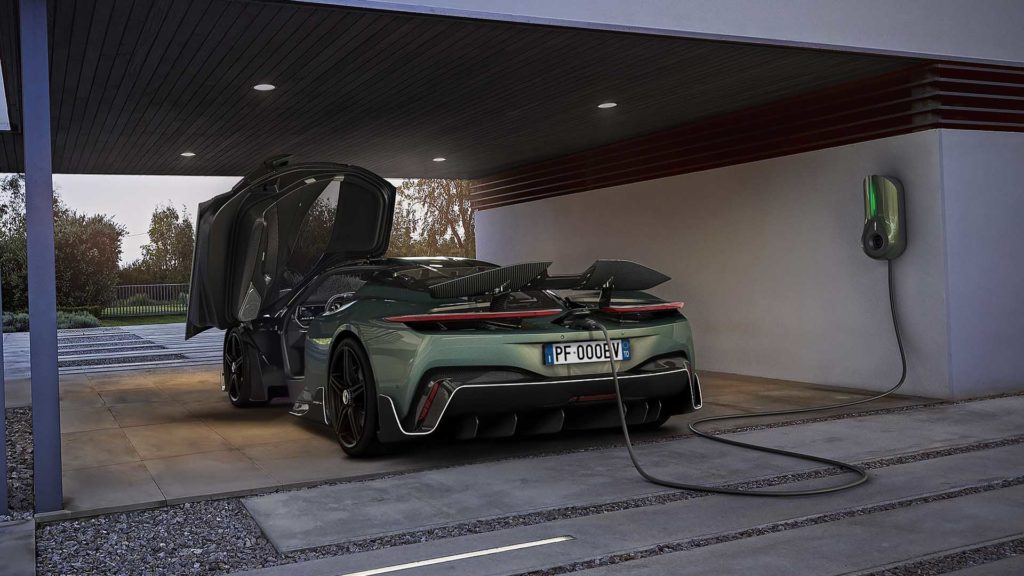
Most new electric cars use Type 2 connectors. You don’t need to worry about choosing the wrong connector, though – your installer will select the correct type for your vehicle.
Then you need to choose the power rating: 3.6kW, 7kW or 22kW. The higher the power, the quicker your car will charge. However, 22kW domestic chargers only work if you have what’s called a three-phase electrical supply to your home. These are rare in the UK, so not many people will have that option.
A 7kW wallbox charges at twice the rate of a 3.6kW device, and three times the rate of a standard plug socket. And as a 7kW device typically costs less than £100 more than a 3.6kW alternative, they are the obvious choice.
You then need to choose between a universal charger and a tethered one. The universal charger only has a socket outlet. You plug the cable that you carry in your car’s boot into the socket and the other end into the vehicle itself.
More convenient is the tethered type, which has a five-metre cable attached to the wallbox. Simply uncoil it and plug it into your car.
Costs of a home charging point

You can find the full list of approved suppliers of home charging points by visiting the government website. Booking an installation can also be done online.
Under the government’s EV chargepoint grant, people who live in flats or rented properties can claim back up to 75 percent of the cost of a fitted home charging point – up to a maximum of £500. You only qualify if your car is on the approved list and you have a private, off-street parking space outside your property.
Equally, those who own a rent or own a property with on-street parking can also claim up to £500. This can contribute towards creating a pavement gully for charging cables, for instance.
To give an example of costs, Pod Point – one of the major players in the supply of domestic EV chargers – offers an untethered 7.4kW home wallbox for £999, or £34 per month over 36 months. Its tethered 7.4kW charger costs £1,049. Note: the £500 grant has not been deducted from these prices.
ALSO READ:
What is preconditioning and how can it boost an electric car’s range?

I use my car throughout the day for work and I can’t charge it at home unless I use a 50m extension lead run from the house to my parking space. How do I run an electric vehicle?
I think you are pretty well ruled out of the game. Even the charger that’s supplied with your car, suitable for a domestic 13-amp socket, will be unhappy with an extension lead, and probably won’t work. So unless you can make charging work elsewhere for you, it’s a no-go, sorry to say.
So what we are in effect saying is that anyone who lives in a terraced house with on-street parking isn’t going to be able to run an EV unless they are prepared to spend several hours a day at a public charging point or their employer has supplied one per member of staff? That is, assuming you have access to a private car park at work.
I don’t have off-street parking at home. My employer doesn’t have a car park for staff. What happens after 2030 when the sale of new diesel and petrol vehicles is banned? Two hours a day queueing up at Tesco with the rest of the residents of the local streets? Or wholesale demolition of pre-war housing and replacement with new properties with designated off-road parking?
Its a total joke, people with no private parking will not be able to charge their car, I live in a block of flats, can often not park nearby, what do I and thousands of others do. The people who think these ideas up are usually well off and live in a house with parking.
THIS PLAN IS SO PLAINLY AND OBVIOUSLY BONKERS TO EVEN SUGGEST THAT WE ALL GO OVER TO E/V S IS STUPID AS PEOPLE SAY WHAT ABOUT PEOPLE IN BLOCKS OF FLATS ?TERRACE STREETS ?? NO DRIVEWAYS ?? AT THE END OF THE DAY ARE YOU TELLING ME THAT THIS VERY SMALL LITTLE ISLAND IS GOING TO IMPACT CLIMATE CHANGE ?? NO DAMN WAY ALL A MONEY MAKING RACKET BY RICH PEOPLE YET AGAIN
[…] the need to connect to a wallbox should make charging the Cayenne Electric more convenient. The Porsche wireless charging plate can […]
[…] from £31,990, the launch package includes a Geely EV Grant, a subsidised home wall box charger and even a £1,000 scrappage incentive for those trading in an old petrol or diesel […]
[…] contrast, only 15 percent believe the aesthetics of a wallbox charger do not […]