

Mild hybrid cars have become incredibly popular. Indeed, figures from the Society of Motor Manufacturers and Traders (SMMT) show the Ford Puma was the UK’s most-registered new car in 2025. And while the Puma is now available in fully electric Gen-E guise, the majority of those sold are mild hybrids.
In this guide to mild hybrid cars – also known as MHEVs – we will explain what the term means, how the technology works and how these vehicles differ from full hybrids and plug-in hybrids.
We’ll also look at the pros and cons of buying a car with a mild hybrid powertrain. Read on for everything you need to know.
What is a mild hybrid car?

A mild hybrid car is often abbreviated to an MHEV (or mHEV), which stands for Mild Hybrid Electric Vehicle. It uses a traditional petrol or diesel engine to send power to the wheels, along with a small, battery-powered electric motor to assist with acceleration, improve fuel economy and reduce exhaust emissions.
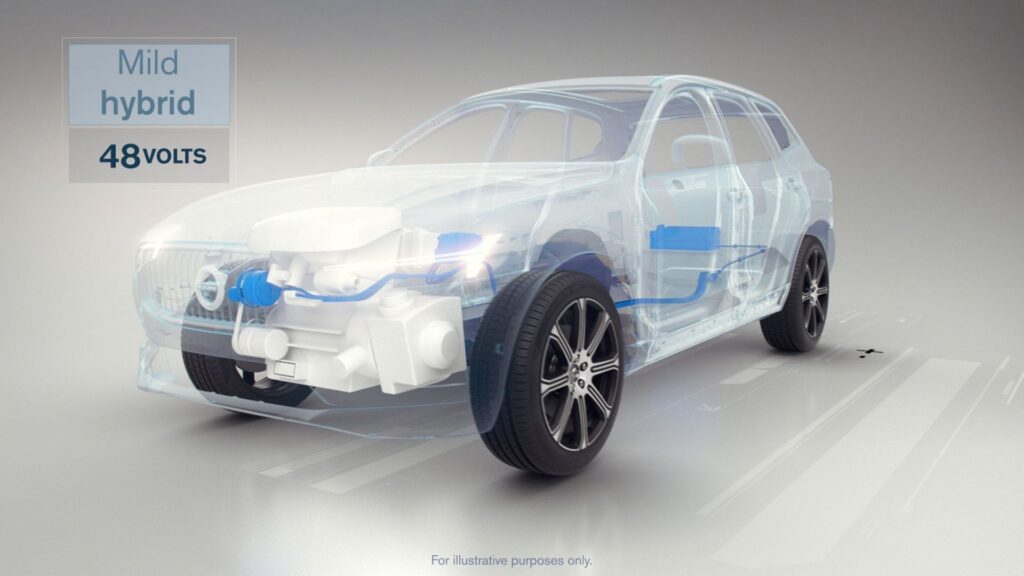
Unlike full hybrids (sometimes referred to as ‘self-charging’ hybrids) and plug-in hybrids, it’s not possible to drive a mild hybrid car for any distance using battery power alone. In most cases, a mild hybrid car has a 48-volt battery that is supplementary to the car’s standard 12-volt battery.
There are several benefits, including smoother engine restarts in traffic, improved fuel economy and quicker acceleration. According to engineering company Delphi, a mild hybrid system can reduce carbon dioxide (CO2) emissions by around 10 percent.
The additional battery can also boost low-end torque (the pulling power of the engine) by an average of 25 percent.
A spokesperson for Delphi said a mild hybrid “offers 50-70 percent of the value of a full hybrid, but at around 30 percent of the cost”.
Not all mild hybrid systems are the same, however. On some Audi vehicles, for example, it’s possible to coast for up to 40 seconds with the engine switched off. The stop-start system is also active at speeds up to 13.7mph.
In 2024, Audi launched MHEV Plus, which uses a pair of electric motors and a 1.76kWh battery pack to boost both performance and efficiency. It also ensures that systems with high power draws, such as the air conditioning, can continue to operate with the engine switched off.
In other cases, such as Suzuki’s 12V Mild Hybrid System, the tech takes the form of an Integrated Starter Generator (ISG). This acts as both a generator and starter motor. The ISG is driven by a belt, assisting the engine during acceleration and generating electricity through regenerative braking. The lightness of the system means that it contributes just 7kg to the weight of a current Suzuki Swift.
How does MHEV technology work?

Although MHEV systems work in different ways depending on the hardware and car maker in question, the approach is essentially the same. The beauty of this technology is that it’s essentially ‘hidden’. A mild hybrid car operates and drives largely the same as a petrol or diesel-engined car without the system fitted.
The small 48-volt battery pack stores energy recaptured from regenerative braking and supplies power to an electric motor (or motors). This energy is either stored or used to supplement the combustion engine, delivering extra torque during acceleration, improving the smoothness of engine restarts in traffic, and helping to reduce the car’s emissions.
The pros and cons of mild hybrid cars

Here, we have listed the pros and cons of mild hybrid cars, including how they compare to full and plug-in hybrid vehicles:
Pros
- Improved fuel economy compared to a traditional petrol or diesel car
- Lower exhaust emissions
- More affordable to buy than full hybrids or plug-in hybrids
- Seamless integration with the car – many owners aren’t aware the MHEV tech is there
- Quicker acceleration thanks to electric boost
- Lower CO2 emissions for tax advantages
- Systems such as the air conditioning can be used with the engine switched off
Cons
- Car cannot run in pure electric mode
- Unable to match the low running costs of full hybrids, plug-in hybrids or electric vehicles
- A petrol MHEV may still be less economical than a conventional diesel car
- Can be pricier to buy than an equivalent petrol or diesel car without MHEV tech
ALSO READ:
What are the differences between a hybrid and an electric car?