

Imagine you own a car that is running low on petrol or diesel. However, you can only fill up at a Shell station if you had previously registered your details with Shell – likewise at an Esso station if you had registered with Esso, and so on.
Instead of around 8,000 petrol stations across the UK to choose from, therefore, you might be limited to only a fraction of that number.
To begin with, this was the situation with electric car charging points. When you registered with just a single provider – and there are many of them – you were restricted to their charging stations only. In order to access a decent range of public EV chargers, you had to spend hours setting up accounts with multiple providers.
Clearly, as many EV early adopters discovered, this made no sense. What we needed was the ability to charge electric cars with the tap of a MasterCard, Visa or American Express.
So, from late 2020, the government ruled that all new electric car charge points must accept credit or debit cards. The same way that automated petrol pumps do, of course.
Will EV charging points take card payment?
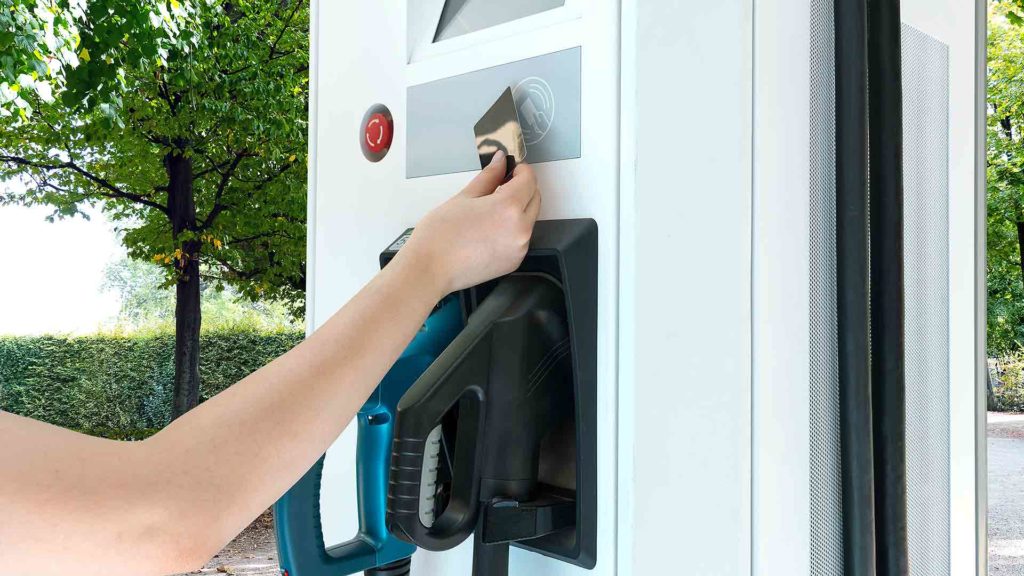
The good news, then, is that electric car charging points do take cards. You can simply turn up and pay, without having to register for an access card or tag first.
All good, then? Well, yes and no, because certain charge point operators run a two-tier system, billing those who haven’t pre-registered more if they simply turn up and pay with a credit or debit card.
At the time of writing, for example, a BP Pulse 50kW charger costs 79p per kWh if you haven’t registered in advance. But register, and agree to pay £7.85 a month, and you only will only pay 63p per kWh. BP Pulse’s equivalent prices for ultra-fast 150kW chargers are 89p and 69p per KWh.
A card-free future for electric cars
Two developments are likely to make the credit or debit card question almost redundant in future. One is that charging via an app on your smartphone will become commonplace.
The other is that new electric cars will have in-built authentication data – known as Plug & Charge technology. You will simply connect to the charging station for payment to be made automatically.

Why don’t relatively new Ionity chargers accept debit/credit cards?
Why don’t the thousands of pre- 2024 chargers accept credit/debit cards?
[…] Because it is fully integrated into the app, the new Zapmap charging card should be a slick alternative to contactless payments. […]