

At the time of writing, there are nearly 120,000 public EV charge connectors across the UK. The majority of these are fast chargers, but there has also been a notable rise in the number of rapid chargers.
If you own an electric car, the chances are you will mainly recharge at home, either using a domestic plug socket or – preferably – via a dedicated wallbox. On longer journeys, though, you may need to access one of the public charging networks.
In truth, you shouldn’t have much trouble finding a place to recharge. There are now more electric charging stations in the UK than conventional fuel stations. Around 80 percent of UK petrol stations have closed since 1970, but the number of charging locations has increased from a few hundred in 2011 to 42,000 in 2025.
Below is a list of 10 of the most significant charge network operators in the UK.
BP Pulse

BP has pivoted from being solely a fuel company to a charging supplier as well, swallowing up the former Polar network in the process. With more than 3,000 rapid and ultra-rapid devices installed thus far, it’s the fifth largest provider in the UK.
The pay-as-you-go price for 7kW fast charging is 65p per kWh. Upgrade to a 50kW rapid charger or 150kW+ ultra-rapid charger and those rates are 83p and 87p respectively. However, if you sign up for BP Pulse membership and pay £7.85 a month, you could potentially make savings. Member prices per kWh are 44p (7kW charging), 63p (50kW) and 69p (150kW+).
There is also a free BP Pulse app to download for charging locations, including live availability, along with your payment history and accessing invoices.
Char.Gy

Working with local governments, Char.gy has grown into a UK-wide network with nearly 4,000 on-street charging points. To keep your conscience clear, it also uses 100 percent renewable energy, supplied from sources such as wind farms or solar panels.
The company has a simple and relatively affordable pricing structure. In the daytime, between 7am and midnight, electricity is charged at 59p per kWh. Late at night, when demand is lower, the price drops to 39p per kWh. There’s no need to sign up in advance; you can simply pay when you fill up.
Char.gy recently celebrated its one millionth charging session since 2018. This apparently equates to 81,590,322 electric car miles enabled.
Gridserve

Gridserve operates some of Britain’s fastest EV chargers. These are located at its rather swish standalone hubs, dubbed Electric Forecourts, along with the Electric Highway network found at motorway services and fuel stations. There is no requirement to become a member, but downloading the Gridserve app can reveal live charger availability and provide access to discounts.
The price for DC charging using contactless payment is currently between 79p and 85p per kWh. Along with cafe facilities, toilets and even rentable office pods with wifi, Gridserve Electric Forecourts provide ultra-rapid chargers delivering up to 360kW – swift enough even for electric hypercars such as the Lotus Evija.
There are currently four Electric Forecourt locations: Stevenage, Norwich, Braintree and London Gatwick airport. But many more are being built or planned, from Yeovil in Somerset to Rutherglen in Scotland.
Instavolt

Instavolt claims to offer the ‘simplest and most transparent’ electric vehicle charging network in Britain. There’s a good spread of rapid chargers across the country – just over 2,000 of them, according to data from Zapmap – the majority of which are situated close to urban centres and major roads.
Instavolt has also partnered with hospitality companies such as McDonald’s, Starbucks and KFC, along with Bannatyne health clubs, to provide convenient charging in car parks.
There are no membership or connection fees. You pay 87p per kWh of electricity used, at chargers that range from 50kW to 160kW in output. Instavolt claims more than 99 percent reliability for its network and, as you’d expect, there is an app to plan and keep track of your charging activity.
Ionity

Ionity operates charging stations along major roads in 24 European countries, with an average of six charging points per station – all powered by renewable energy. Crucially, it offers a charging capacity of up to 350kW, making it ready for the next generation of electric cars – along with the most powerful EVs of today.
Turn up with your debit or credit card and you will be charged 79p per kWh. This decreases to 75p with the Ionity app, or much less with a subscription. For £5.49 a month, Ionity Motion reduces the rate to 53p per kWh. And for heavier users, Ionity Go at £10.50 a month means you’ll pay 43p per kWh.
Ionity has the backing of numerous car companies, including Volkswagen, Ford, BMW, Hyundai and Mercedes-Benz. It also works with operators such as Extra motorway services in the UK.
MFG EV Power

MFG EV Power chargers are frequently found on the forecourts of existing petrol stations; the company has partnerships with BP, Shell, Esso, Texaco, Jet and Murco. You can also find them on-site at McDonald’s, Burger King, Greggs, Costa, Pret and other eateries.
As of July 2025, it has more than 1,000 ultra-rapid EV charging bays across its network, with 3,000 chargers planned by 2030.
A fixed price of 79p per kWh keeps things simple, and drivers are offered a choice of 50kW, 150kW, 300kW and 400kW chargers, depending on the location. For reference, an electric car charging at 150kW can add approximately 100 miles of range in 10 minutes. Typically, you can expect to find between four and eight ultra-rapid charging bays at an MFG EV Power hub.
Osprey

Osprey started in 2016 and had installed its 100th EV charging point by 2020. Today, it has more than 1,000 locations in the UK, including partnerships with certain pub chains and garden centres. The long, spring-loaded cables seen above aim to make chargers as easily accessible as possible.
Whether you use the app or a bank card, Osprey has a flat tariff of 82p per kWh across its network. You can also pay via ApplePay, Google Pay and Android Pay. In terms of speed, chargers range from 50kW to 300kW. According to Osprey, a Kia EV6 will take 53 minutes to charge using the former, or 18-22 minutes with the latter.
Pod Point
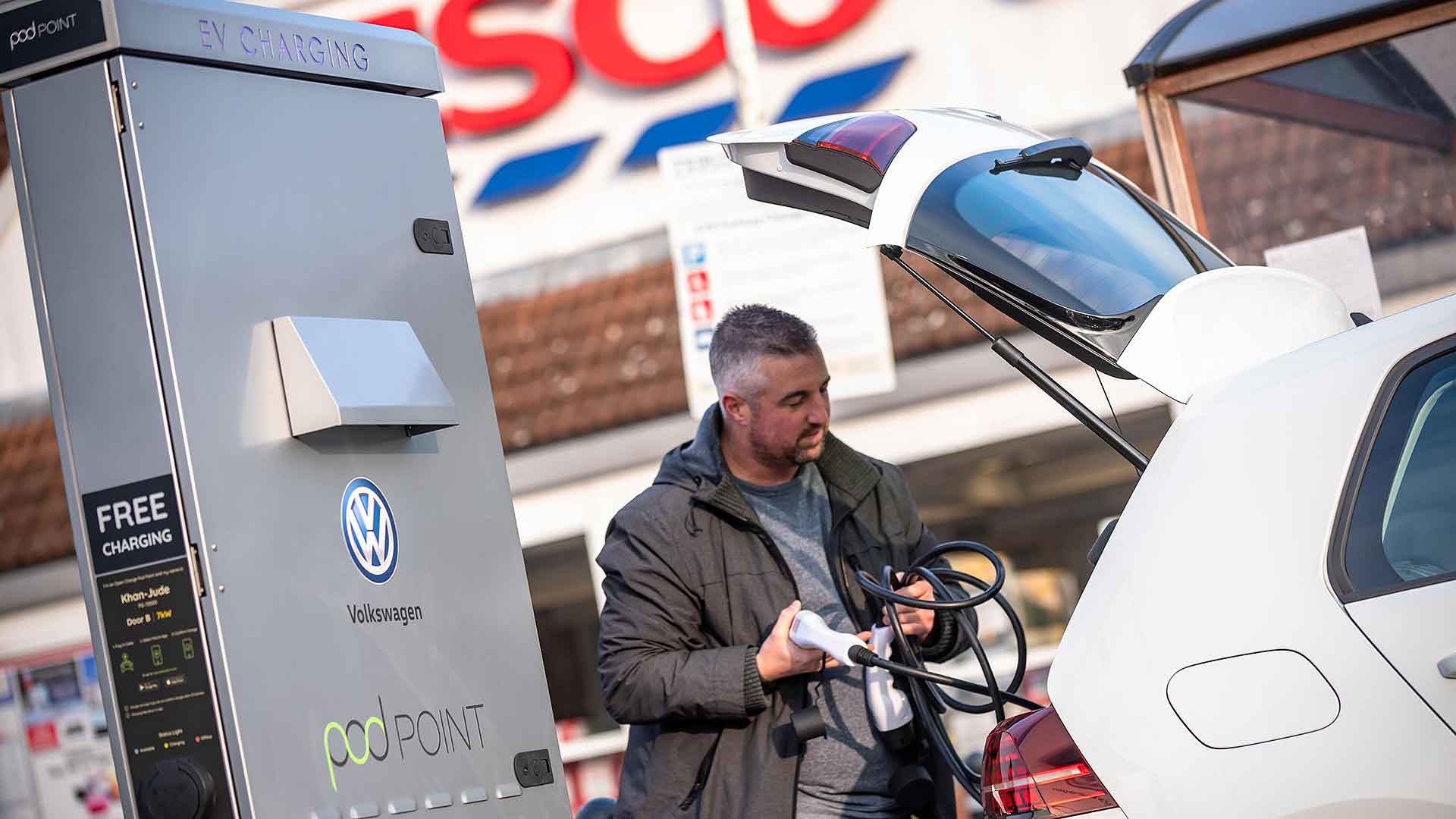
You might know Pod Point primarily as a supplier of home EV chargers. However, the company also operates more than 5,000 public charging points, including 75kW rapid chargers at Tesco stores across the country. Theoretically, these can add around 180 miles of range in 30 minutes.
Prices vary according to location, but start from around 35p per kWh on slower devices. Sadly, the days of free charging at Tesco in partnership with Volkswagen (pictured above) are now over.
There is no Pod Point membership scheme or subscription – you simply download the smartphone app. Charging will start as soon as you plug in and will stop after 15 minutes unless you confirm the charge via the app.
Tesla Superchargers
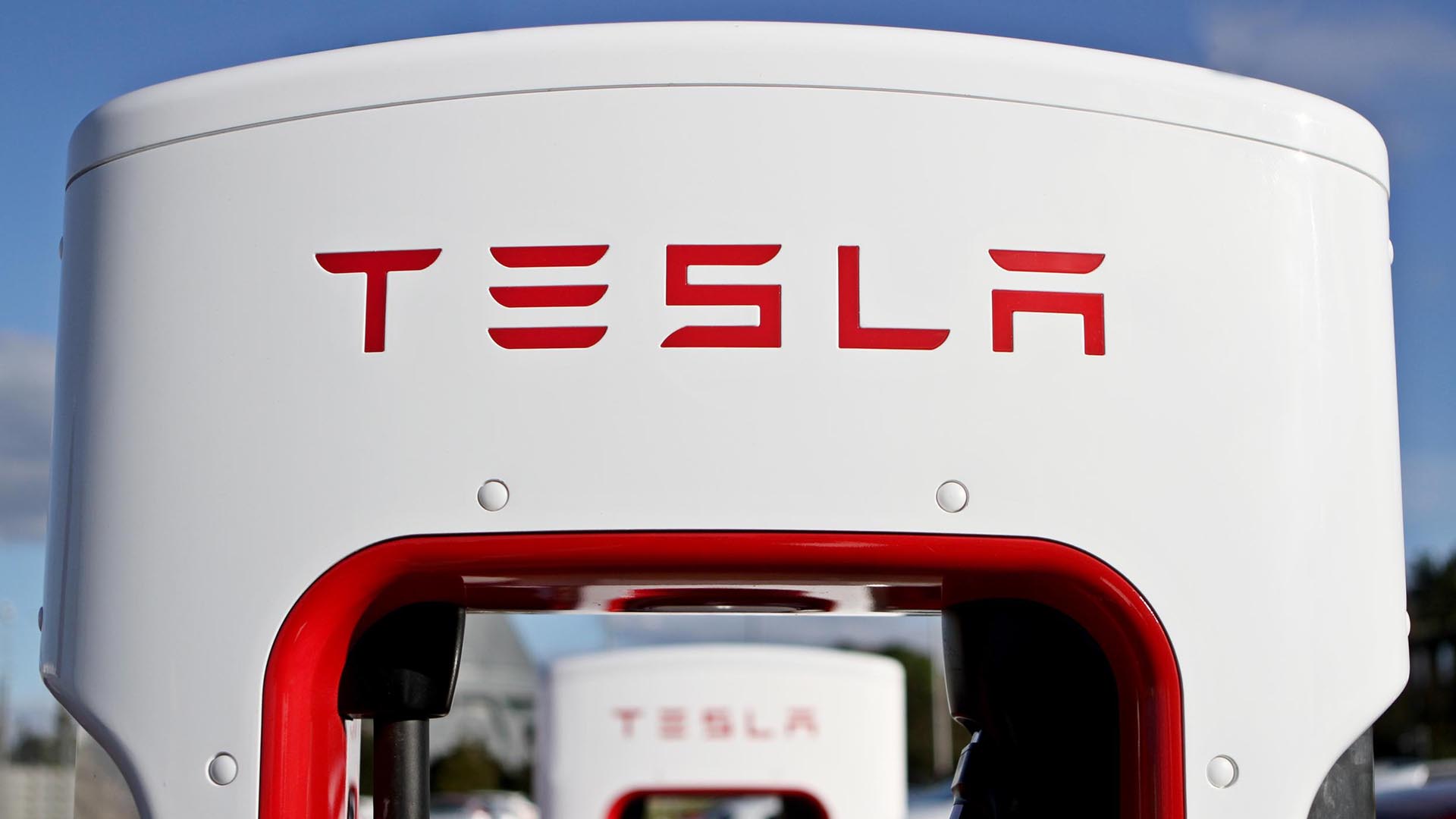
There are two networks available to Tesla owners: Supercharger and Destination. As of mid-2025, there are around 7,500 Supercharger stations across the globe, with approximately 70,000 connectors. As their name suggests, Destination chargers are located at places where you will spend more time. These include hotels, restaurants and shopping centres.
Supercharging a Tesla generally takes around 30 minutes. However, it’s worth noting that the company charges idle fees for vehicles left connected when fully charged. In the UK, this penalty is 50p per minute when the Supercharger station is at 50 percent capacity, or £1 per minute when the site is at 100 percent capacity. Some drivers of early Model S and Model X vehicles get free charging, but all others have to pay.
In recent years, parts of the Supercharger network have been opened up to drivers of non-Tesla electric cars. For the latest locations, visit the Zapmap website and use the ‘Tesla Public Supercharger’ filter when searching for nearby devices.
Shell Recharge

The Shell Recharge network is now the largest in the UK, with close to 11,000 chargers nationwide. Like BP Pulse, it sees a petrol retailer making major provisions for electric cars. Charging speeds of up to 180kW are available.
There’s no subscription cost, and prices vary according to location. At the time of writing, they range from 59p to 89p per kWh, reduced by 10p per kWh if you use the Shell Recharge app and Charge Card.
Interestingly, Shell’s former petrol station in Fulham, London has recently been redeveloped into an EV hub featuring 10 chargers rated at 175kW, and partially powered by solar panels on the canopy. Will other traditional fuel stations follow? It seems only a matter of time.
ALSO READ:
Charging an electric car: what you need to know

I have used Instavolt several times in Hamworthy, Dorset. 120kW. The Yachtsman. Twice, both times reliable, I have also used MER 60kW chargers in Wareham, Dorset, but they are not to be relied on, as 90% of the time they do not work. POOR MAINTENANCE. Between April and September 2025
My home charger is much cheaper at 7p per kWh. I drive a Skoda Enyaq Sportline 85x with MOBILITY.